
Before Your AI Receptionist Goes Live: 7 Things It Needs to Know About Your Business
Before your AI receptionist goes live, it needs accurate business rules, booking logic, and clear boundaries, not just a phone number and generic instructions.

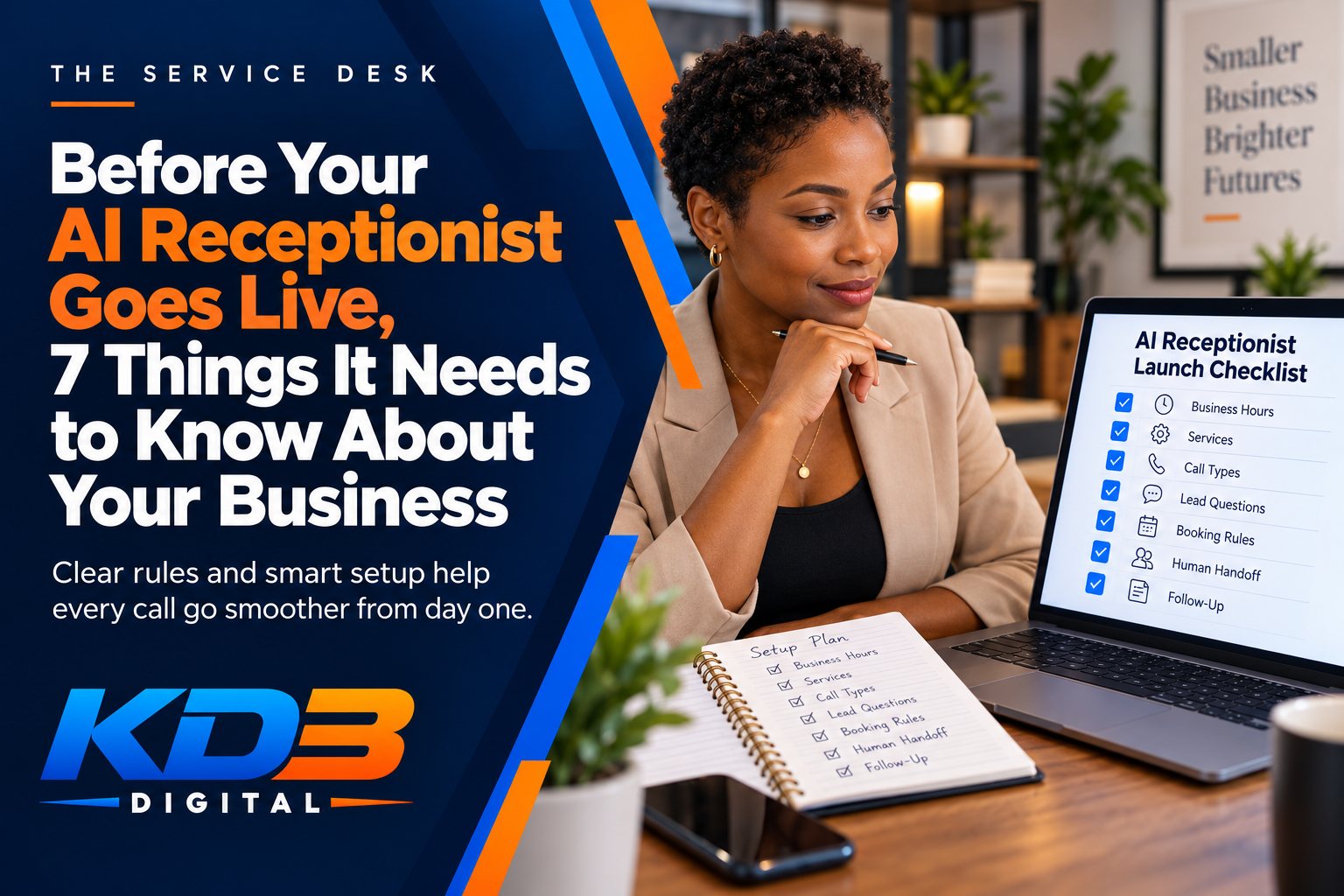
Key Takeaways for Small Business Owners
- An AI receptionist needs accurate business rules before it needs clever conversation.
- Decide what the AI can handle, what it should collect, and what must go to a person.
- Booking only works when the calendar rules match the way your business really operates.
- The AI should never guess about pricing, availability, policies, or information it has not been given.
- Testing real call scenarios before launch is part of the setup, not an optional extra.
An AI receptionist should not go live with generic instructions and a phone number. To handle calls well, it needs a clear picture of how your business actually works, what it can do for a caller, and when it should bring a person into the conversation.
That matters because customer expectations are moving in two directions at once. People want faster access to help, but they also want accuracy and transparency. Zendesk's 2026 CX Trends report found that 74% of consumers now expect customer service to be available 24/7 because of AI, and 88% expect faster response times than they did a year earlier. Twilio's 2025 State of Customer Engagement research also found that 54% of consumers want to know when they are talking to AI rather than a human.
1. Start With the Information Customers Ask for First
Before an AI receptionist can answer well, it needs a reliable source of truth about the business.
That usually includes your regular business hours, holiday or special hours, service area, services offered, services not offered, main contact information, appointment types, and any basic policies customers frequently ask about.
This sounds simple, but outdated information creates avoidable problems. If your website says one thing, your calendar says another, and your AI receptionist has a third set of instructions, the customer is the one who experiences the confusion.
The goal is not to give the AI every fact your company has ever collected. Give it the information it actually needs to handle common calls accurately.
2. Decide Which Calls the AI Should Handle
Not every caller is calling for the same reason. A new prospect asking about service is different from an existing customer with a problem, a vendor asking for accounts payable, or someone calling about a job opening.
Before launch, define the main call types your business receives and what should happen with each one.
For example, a new lead may need to be greeted, asked a few qualifying questions, and offered an appointment. An existing customer may need to be identified and routed to the right person. A caller asking for something outside the AI's approved scope may simply need a message taken.
Clear call paths make the experience feel organized. Without them, even a capable AI can sound uncertain because the business has not decided what should happen next.
3. Choose the Questions That Actually Help Qualify a Lead
An AI receptionist does not need to conduct a twenty-question interview before a customer can move forward.
For many service businesses, the useful information is straightforward: the caller's name, best callback number, what service they need, where the service is needed, how urgent the request is, and whether they want to schedule.
The exact questions should match the business. A lawn-care company may need the property location and type of work requested. An HVAC company may need to know whether the issue is heating or cooling and whether the system is completely down. A med spa may need to know which service the caller is interested in before presenting appointment options.
Ask only what helps the business take the next step. Too many questions create friction. Too few can leave staff with a lead they still have to chase for basic information.
4. Set the Booking Rules Before Connecting the Calendar
Connecting an AI receptionist to a calendar is not the same as deciding how appointments should be booked.
The business still needs rules. Which appointment types can be booked? How long is each appointment? How much buffer time is required? Can someone book the same day? Are certain services available only on particular days? Does location affect which calendar or team member should receive the appointment?
Those rules should be decided before the AI begins offering times to callers.
A good booking experience feels simple to the customer because the complexity has already been handled behind the scenes.
5. Define When a Human Should Take Over
An AI receptionist should have a clear job, not an unlimited one.
Some conversations are better handled by a person. That may include an upset customer, a complex quote, an unusual service request, an account-specific issue, a caller who repeatedly asks for a human, or a situation where the AI cannot confidently answer from its approved information.
The handoff rule should be specific. The AI may transfer the call during business hours, take a detailed message after hours, or notify a designated person depending on the situation.
This protects the customer experience and prevents the AI from trying to solve a problem it was never meant to handle.
6. Tell the AI What It Must Never Guess
This is one of the most important setup rules.
If pricing changes by job, the AI should not invent a price. If a service is not listed in its approved information, it should not assume the company provides it. If the calendar does not show an opening, it should not promise that someone can squeeze the customer in.
When the answer is not known, the better response is to say that the information needs to be confirmed, collect the caller's details, and move the conversation to the correct next step.
Transparency matters here. Twilio's 2025 customer engagement research found that more than half of consumers surveyed wanted to know when they were interacting with AI. The goal is not to make an AI receptionist pretend to be something it is not. The goal is to make the experience helpful, clear, and professional.
7. Decide What Happens After the Call
A successful call does not end when the caller hangs up.
Decide where the information goes. Does the lead become a contact in your CRM? Does the owner or staff receive a notification? Does a booked appointment trigger a confirmation? Does someone need a call summary? What happens if the caller was qualified but did not book?
This is where implementation matters. The receptionist is one part of a larger customer-response system. If the AI captures good information but nobody sees it, the business has only moved the missed opportunity from the phone to another inbox.
Pre-Launch Checklist
Action Checklist
- ✓Business hours and special hours are accurate.
- ✓Services and service-area information are current.
- ✓Lead-qualification questions are approved.
- ✓Calendar and booking rules are defined.
- ✓Human handoff and escalation rules are clear.
- ✓Topics the AI must not guess about are documented.
- ✓Call summaries, notifications, and lead destinations are configured.
- ✓Realistic test calls have been completed before launch.
KD3 Digital Practical Tip
Test your AI receptionist like a customer, not like the person who built it. Call after hours. Ask a vague question. Change your mind halfway through the call. Ask for a person. Try to book a time that should not be available. Mention a service you do not offer.
Those test calls reveal whether the business rules are clear enough for the AI to handle real customers, not just perfect demo conversations.
Sources & Further Reading
- Zendesk: CX Trends 2026, customer expectations for faster and 24/7 service.
- Twilio: 2025 State of Customer Engagement Report, research on AI, trust, transparency, and customer engagement.
Related Reading
What Should an AI Receptionist Actually Do for a Small Business?