
AI Receptionist vs. Answering Service vs. Voicemail: What's the Difference?
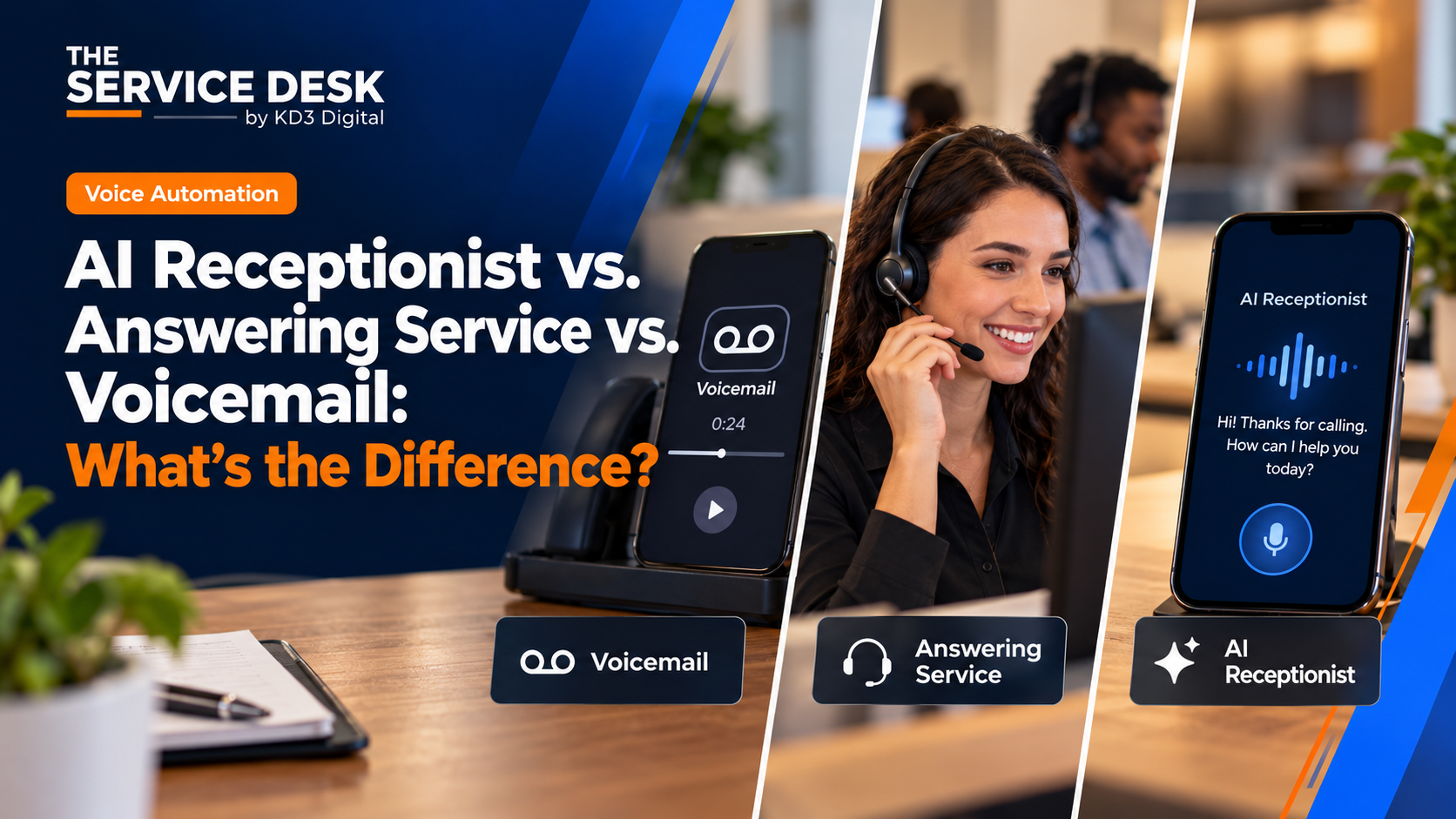
Voicemail records a message. An answering service provides a live human. An AI receptionist handles the repeatable parts of a call automatically, and the right answer depends on what your callers actually need.

Key Takeaways for Small Business Owners
- Voicemail records a message but doesn't continue the customer's journey.
- A traditional answering service provides a live human conversation.
- An AI receptionist can handle repeatable call tasks automatically.
- Businesses don't have to choose between humans and AI for every call.
- The right system depends on what your callers actually need.
If you can't personally answer every call that comes into your business, you have more choices than you used to.
There's voicemail.
There are traditional answering services staffed by people.
And increasingly, there are AI voice receptionists capable of having an actual conversation with the caller.
Those options overlap, but they don't solve the problem in exactly the same way.
Voicemail: simple, familiar and passive
Voicemail is still useful.
The caller hears a greeting, leaves information and waits for someone to respond.
For a current customer with a routine question, that may be perfectly acceptable.
Where voicemail becomes weaker is when the caller wants to take action immediately.
A person looking for a plumber, consultation, estimate, appointment or service provider may not want to leave a message and wait.
In CallRail's 2025 consumer survey, 42% said they would leave voicemail after an unanswered call, but 21% said they would immediately call another business.
Traditional answering service: a person answers
An answering service places a human being on the other end of the line.
That's valuable when a conversation needs judgment, flexibility or empathy.
Human receptionists can deal with callers who don't explain themselves neatly. They can pick up emotional cues, deal with unusual questions and recognize when something doesn't fit the standard process.
For some businesses, that's exactly what is needed.
The tradeoff is that you're purchasing human labor. Pricing, capacity, training and how much the answering service actually knows about your business can vary.
AI receptionist: automate the repeatable part
An AI receptionist sits in a different place.
Instead of simply recording a message, the system can be configured to have a conversation based on approved business information and workflows.
For example:
- What service do you need?
- What ZIP code is the property in?
- Are you an existing customer?
- Would Tuesday at 2:00 or Wednesday at 10:00 work better?
Invoca's 2026 home-services research specifically describes voice and SMS agents being used to qualify jobs, book visits, schedule callbacks and route high-intent callers, including during after-hours periods and call surges.
So which one is better?
That's the wrong question.
The better question is:
What needs to happen during your calls?
If you simply need someone to take a message, voicemail may be enough.
If conversations are highly unpredictable or sensitive, human answering may be the stronger choice.
If a large percentage of calls involve repeatable intake, common questions, qualification and scheduling, an AI receptionist becomes more interesting.
And many businesses may ultimately use a combination.
People still need an escape route
Automation should not turn into a maze.
Gartner surveyed 3,566 customers in early 2026 and found that 87% considered access to a human agent essential when companies use generative AI in customer service. Half also said GenAI made interactions easier.
Those findings aren't contradictory.
Customers can appreciate automation while still wanting a person available when the situation calls for one.
That should influence how an AI receptionist is designed.
KD3 Digital Practical Tip
Write down the five most common reasons people call your business.
Next to each one, mark it:
- Routine
- Needs judgment
- Needs immediate human attention
If most of your calls fall into the first category, you may have a good automation opportunity.
If almost everything requires judgment, that tells you something too.
See what an AI receptionist can do
KD3 Digital currently specializes in managed AI Voice Receptionist systems for service businesses.
Explore the demo at https://kd3digital.com/demo.
Sources & Further Reading
- CallRail: Consumer research on missed calls: https://www.callrail.com/blog/missed-calls-cost-businesses-more-than-ever
- Invoca: 2026 Home Services Lead Conversion Benchmarks: https://www.invoca.com/reports/the-invoca-home-services-lead-conversion-benchmarks-report-2026
- Gartner: 2026 consumer research on AI customer service and human access: https://www.gartner.com/en/newsroom/press-releases/2026-08-04-gartner-survey-finds-87-percent-of-customers-say-companies-using-genai-for-customer-service-must-provide-access-to-a-human-agent0