
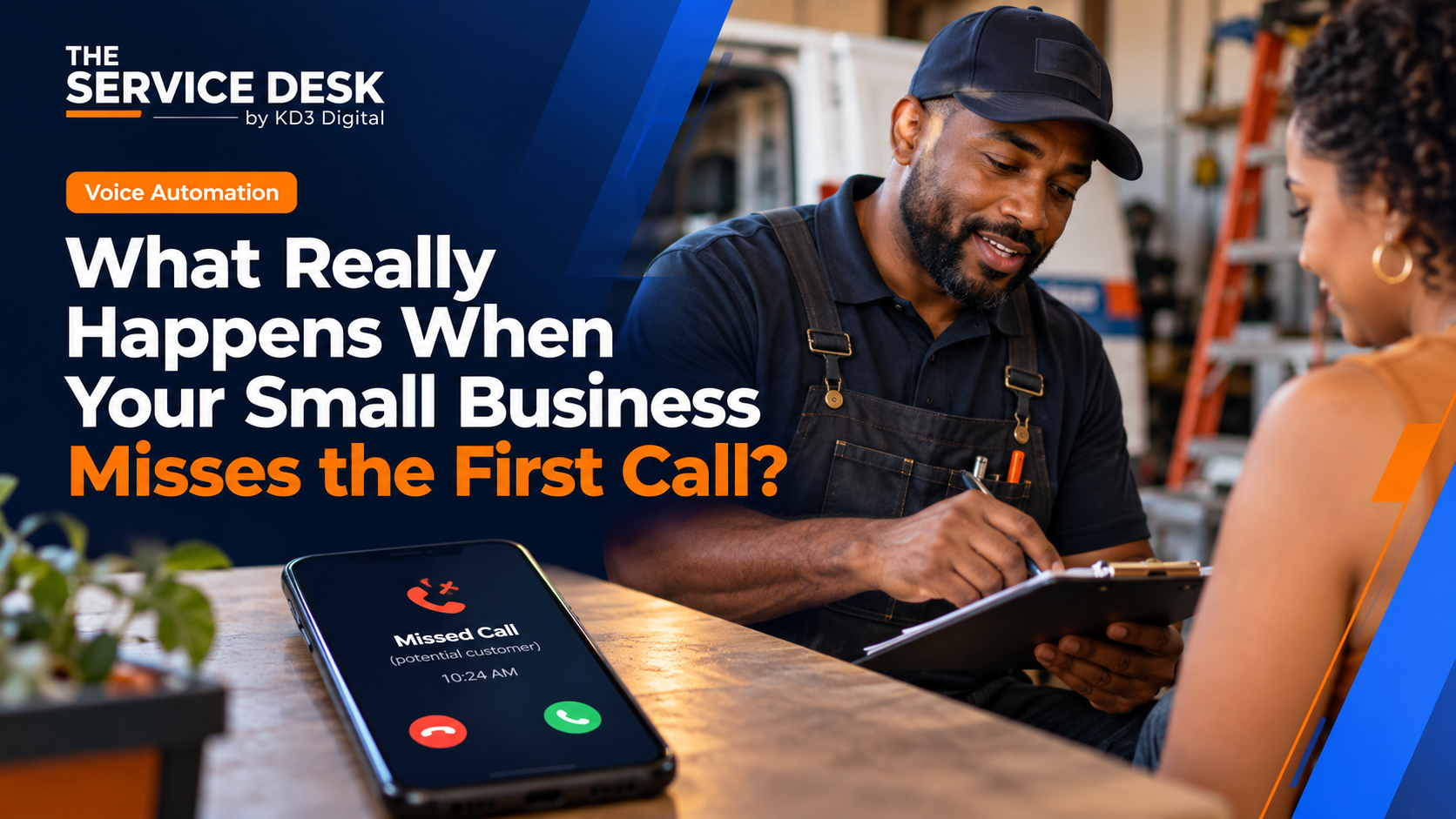
What Really Happens When Your Small Business Misses the First Call?
A missed call isn't automatically a lost customer, but it hands the caller a reason to try the next business.

Key Takeaways for Small Business Owners
- A missed call isn't automatically a lost customer, but it creates an opportunity for the customer to keep looking.
- Phone callers can represent high-intent prospects who have already moved beyond casual browsing.
- A marketing campaign can work perfectly and still fail at the point where someone calls.
- The first thing to measure isn't hypothetical lost revenue. It's how many legitimate calls go unanswered and what happens afterward.
A missed phone call can look harmless when you're already busy running a business.
You're with a customer. You're driving. You're on another call. You're working with your hands. You see the missed call and think, I'll call them back when I get a minute.
The caller may not be waiting.
The caller has already made a decision
Someone who picks up the phone has usually taken several steps before you ever hear the ring.
They may have searched Google, compared businesses, looked through reviews, visited your website or asked someone for a recommendation.
Then they chose to contact you.
That makes the phone an important conversion point.
Invoca's 2025 benchmark analyzed more than 60 million calls across several industries and found that phone conversations continued to play a meaningful role in converting leads into customers. Among the phone leads in its dataset, 37% converted during the call. That shouldn't be treated as a universal small-business conversion rate, but it does illustrate why inbound calls deserve attention.
What happens when nobody answers?
Sometimes the caller leaves voicemail.
Sometimes they try again.
And sometimes they simply call the next business.
A 2025 CallRail survey of 1,000 U.S. consumers found that after an unanswered call, 42% said they would leave voicemail, while 21% said they would immediately call another business. CallRail also reported that 78% of respondents had taken their business elsewhere after failing to reach a company by phone.
Those numbers don't mean every missed call represents a lost sale.
They mean you shouldn't assume the caller will wait for you.
Your marketing may not be the problem
Imagine paying for Google Ads, local SEO, Facebook advertising, a new website, or a referral program.
Then the marketing works.
Someone calls.
And nobody answers.
At that point, the breakdown didn't happen in lead generation. It happened after the lead arrived.
That is an important distinction because businesses sometimes spend more money generating leads when the larger problem is handling the ones they already have.
Start by finding the leak
Before calculating how much money missed calls are supposedly costing you, look at the actual behavior in your business.
For the next week, track:
Action Checklist
- ✓How many inbound calls came in?
- ✓How many were answered?
- ✓How many went to voicemail?
- ✓How many were new prospects?
- ✓How many received a callback?
- ✓How many eventually booked?
You may discover that the real problem isn't all day.
Maybe calls are being missed between 4:30 and 7:00.
Maybe lunchtime is the trouble spot.
Maybe your employees are answering almost everything except when several customers call at once.
Now you have something concrete to fix.
Where an AI receptionist fits
An AI receptionist can provide another layer of call coverage when you or your staff can't answer.
Depending on the system, it can greet the caller, determine why they're calling, collect contact information, answer approved questions, qualify a prospective customer, offer available appointments, book a next step, and route or flag calls that need human attention.
The point isn't to make AI run the business.
The point is to keep a legitimate customer from reaching a dead end simply because you're busy doing the work they called you to hire you for.
KD3 Digital Practical Tip
Pull your call history for the last seven business days.
Don't guess.
Count.
If unanswered calls are rare, you may not have a serious problem.
If they're showing up consistently, you've found an operational gap worth addressing.
The real question
Almost every busy business will miss a call eventually.
The more useful question is:
What happens to the customer when you do?
If your current process is voicemail followed by "I'll call them back when I remember," that's where I'd start.
See how an AI receptionist works
KD3 Digital helps service businesses use an AI Voice Receptionist to answer, qualify, capture and book callers when staff can't get to the phone.
Explore the AI Voice Receptionist demo at https://kd3digital.com/demo.
Sources & Further Reading
- Invoca: 2025 Call Conversion Industry Benchmarks: https://www.invoca.com/press-release/invoca-releases-definitive-cross-channel-and-cross-industry-buyer-conversion-benchmark-report
- CallRail: 2025 consumer research on unanswered calls: https://www.callrail.com/blog/missed-calls-cost-businesses-more-than-ever
- CallRail: Unanswered Calls reporting guidance: https://support.callrail.com/hc/en-us/articles/5712132142605-Unanswered-calls-report
- Harvard Business Review: The Short Life of Online Sales Leads: https://hbr.org/2011/03/the-short-life-of-online-sales-leads
Missed-Call Revenue Calculator
Stop guessing. Estimate what unanswered calls are actually costing your business.
Your Call Data
Full Funnel & Recovery
Estimated Revenue at Risk
Want KD3 Digital to set this up for your business?